 Book a Discovery Call →
Book a Discovery Call →
Book a Discovery Call →
Smart Screen Advertising Platform
One platform that pools digital screens at any number of locations, fills them with ads, and proves what each ad achieved. Software and hardware integration, delivered as one system.
Audience
Radar and on-device camera analysis report how many people stood in front of each screen, for how long, during each ad.
Response
A fresh QR code on every ad play ties each scan to one screen, one creative and one second in time.
What it does
We design and deliver the complete advertising system for physical digital screens: the player on the screen, the sensors beside it, the ad server behind it and the reporting on top. Take it as a ready solution, or have us deploy it around your network.
Every screen, whatever its type or owner, runs one player and takes ads from one ad server.
02How many people were in front of each screen, for how long, during each ad.
03A fresh QR code on every play ties each scan to an exact screen, ad and moment.
04Ads chosen by time, place, context and measured performance. Built-in experiments show the true lift.
The gap
Advertisers still have no accepted way to verify what a screen delivered. These are the five questions they ask, what the market answers today, and what this system answers instead.
How the system works
Each screen carries a player and its sensors. They send signed play logs and audience counts to the central platform, which sends back ads and schedules. The platform joins every play with its audience, context and scans into one record.
Capability one
Every screen in the network runs the same player and takes its ads from one central ad server, so a campaign can be booked across hundreds of locations in one step.
The system speaks OpenRTB 2.6, the industry standard with dedicated fields for physical screens. It connects to existing exchanges so agency budgets can reach the network without you building an exchange of your own.
The highest-value available ad always wins the slot. House ads sit at the bottom, so the screen is never blank.
Capability two
Two sensors, each doing the job it is good at. Radar on every screen for count and dwell. Cameras on a sample of screens for attention. Each reading is matched to the ad playing at that second.
A small module in or beside the screen tracks people as moving points. No image and no device identifier is ever captured.
Analysis runs entirely on the device. Frames are analysed in memory and discarded. Nothing is stored or sent.
Cameras on a sample of screens per venue type give a dwell-to-attention ratio. That ratio is applied to radar-only screens of the same type, so the whole network gets attention estimates at radar cost, with cameras only where the venue permits them.
An ad is credited with a viewer only when that person faced the screen for at least one to two seconds inside the ad's slot. The common industry rule credits every ad that overlapped a person's presence.
Other sensors we integrate
Venue entrance footfall, so screen audience can be compared against total venue traffic.
Body counts where a venue already has cameras. Good for counts, weaker for attention.
Tracking in wide, open zones out to 12 m.
Roadside screens. Counts vehicles and applies an occupancy factor.
Capability three
Every response to an ad is tied to the exact screen, creative and moment that produced it, because the screen draws a fresh QR code for each play.
No scans yet. Press the button, or point a phone at the code.
Conversion endpoints
Any fixed response channel on a screen, such as a promo code or phone number, is attributed to the creative playing at that second by matching against the play log. Advertisers can send back orders, leads or redemptions through an API or a file upload, matched to the original scan token.
Capability four
Cold brew and a quiet table, till 6 pm.
20 s creativeOne HTML5 template with swappable parts, such as price, city name, countdown or offer, produces many versions of an ad without new design work. For low-powered players the server renders the finished image, so the same campaign runs on every screen type.
Controlled experiments
Because the system controls delivery, it can randomly hold a campaign back from 5 to 10% of eligible plays, or from a matched set of screens. Comparing response with and without the ad gives the lift the campaign caused, not just a raw count. It needs no personal data and no consent.
Illustrative numbers on 400,000 eligible plays. A larger holdout costs more plays and tightens the answer.
Pricing models the data supports
The data
What played, who was there, what was happening and what followed, joined on a single clock. Pick a layer to see what it holds and how trustworthy it is.
Source: Player and ad server
For the network operator, each screen owner and each advertiser, with their own access levels.
Scheduled reports and CSV exports.
For agencies and advertisers who want the data in their own tools.
A campaign report that states the method behind each figure, ready for third-party audit.
Design principle
We collect what is clean, cheap and provable. These signals are possible in a lab, or were common in the past. We leave them out because they are inaccurate in the field, legally exposed, or both.
Screens and hardware integration
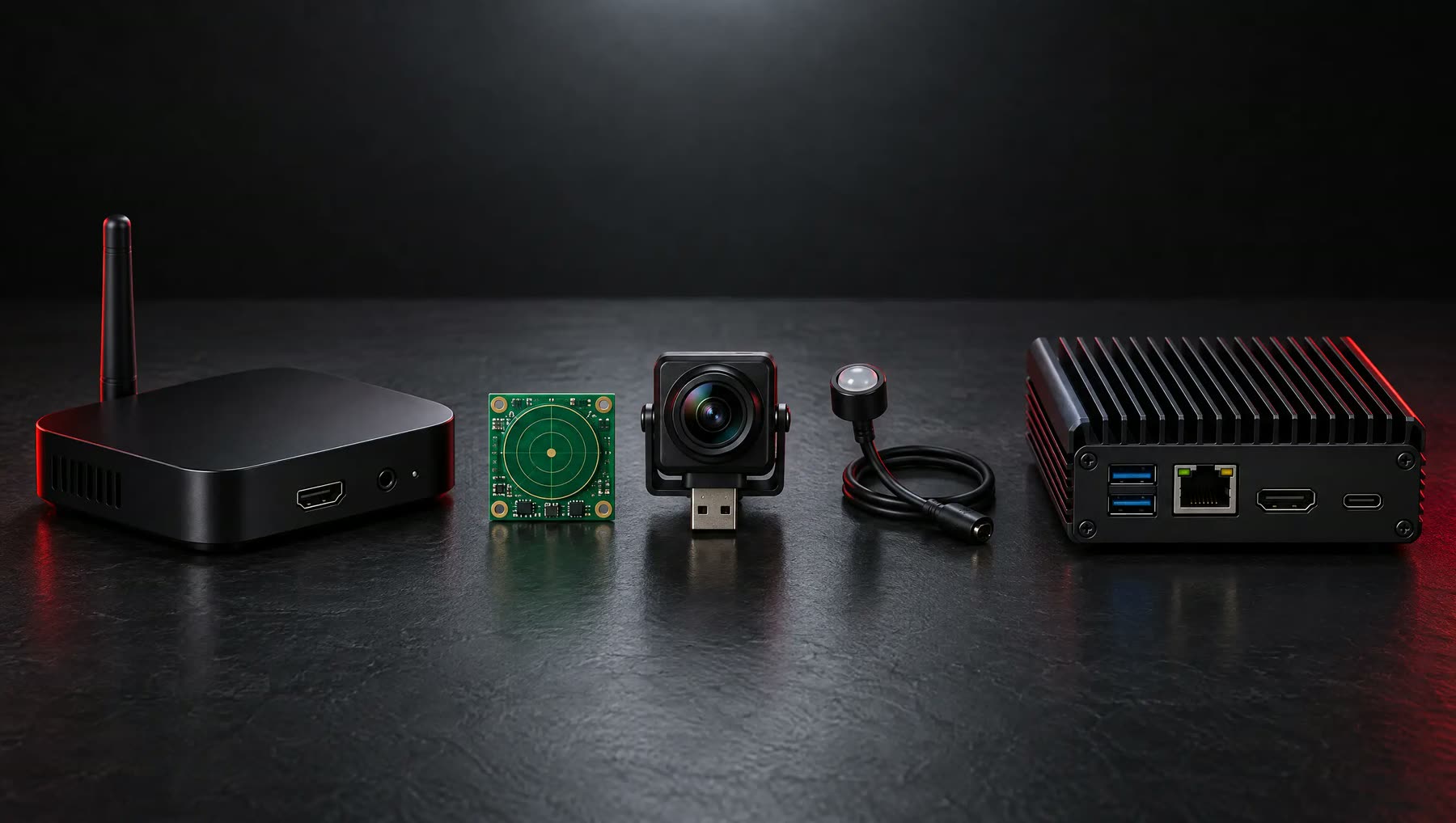
The intelligence sits in our software, and we specify, integrate and quality-check the hardware it runs on: player boxes, radar, cameras and LED controllers. Everything is commercially available, so no part of the system depends on a single hardware vendor.
A small box we specify plugs into any screen with an HDMI port.
Ordinary TVs and most existing screensOur player installs directly on signage-grade panels and starts on boot.
Samsung, LG, Sony and Philips commercial displaysOur player runs on the Android-based controller that drives the LED wall.
Indoor and outdoor LED walls and billboardsOur player runs as a web page inside a network's existing signage software.
Established networks that keep their own softwareAlso supported: video walls, interactive touch kiosks with touch events, and shelf-edge and stretched bar displays in retail aisles.
System configurations
The system is modular. Nothing already installed has to be replaced when a screen moves up a tier.
Most networks do not need the Attention configuration everywhere. A sound design puts Measured on every indoor screen and Attention on a sample of screens in each venue type, enough to calibrate the rest.
Privacy by design
One rule runs through the whole system: only counts and durations ever leave the screen.
Built for India's data-protection regime now, and mirroring the conditions European regulators set for anonymous audience measurement on advertising screens.
How to work with us
Stackbinary is a software development company. This platform is something we have designed end to end, and we deploy it the way your business needs it.
Player, ad server, screen registry, owner portal, QR attribution, dashboards and billing, hosted and supported by us. Start with the Core configuration and add measurement as you grow.
Where you already run signage software, our web player and ad server sit inside it. You keep your screens and content system and gain ad filling, proof-of-play, QR attribution and experiments. Sensors can be added later.
New screen types, new sensors, a specific exchange, your CRM or till system, a custom advertiser portal. We build the integration, on fixed scope and with weekly working demos.
Design, build, hosting and support for the full system.
Hardware specification, integration and quality control for players and sensors.
Installation guides and remote device management.
A pilot that validates sensor counts against manual counts, with the method published.
Next step
A thirty-minute call on your screens, your venues and your advertisers. A written fixed price within days, and an honest no if it is not worth building.
Book a Discovery Call →